I was hoping after the Jeju Air crash in Muan, South Korea, in December that I wouldn't have to write about such incidents for a while. However, we saw another major air disaster barely a month after that, this time in the United States.
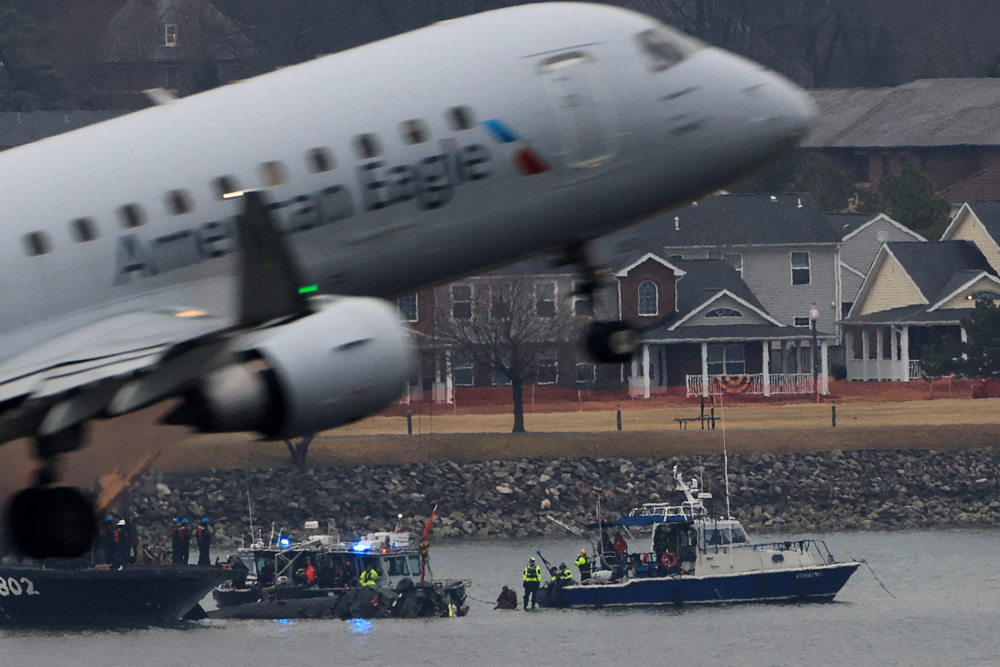
An American Eagle Bombardier CRJ700 airliner was, while trying to land at Ronald Reagan Washington National Airport, hit by a military Black Hawk helicopter.
From media reports, it appeared that the helicopter smashed directly into the fuselage of the CRJ700, breaking it into three pieces, with both damaged aircraft falling into the Potomac River.
As a result, 67 people died: all 60 passengers on the plane, its four crew members, and all three officers on the helicopter.
At the risk of sounding repetitive, I must say here again that serious incidents only occur when multiple mistakes happen.
These aren't accidents: they are the results of carelessness on the part of more than one person.
Reagan National is one of the busiest airports in the United States. The take-off and landing routes were planned decades ago when the airport was first built but capacity has greatly increased over the years.
The military airbase is on the other side of the river from the main runway but military helicopters are allowed to take off and cross the landing path of commercial aircrafts at almost right angles to each other, though there should be a vertical separation, with planes flying at above 122 meters while helicopters are limited to 61 meters to ensure minimum risks of collision.
But, even with this provision, there have been many cases where planes needed to abort landings to avoid sudden take-offs by military helicopters on training exercises.
We may never know what actually caused the collision late last month, but I can hazard a few guesses, based on information available on the media and YouTube.
For obvious reasons, military helicopters communicate on ultra high frequency radio channels, different from the very high frequency used by commercial aircraft.
The pilots on both aircraft cannot, therefore, communicate directly with each other.
Air traffic controllers can, however, communicate with both of them but only on separate communicating channels.
During peak periods or when there is less than a full complement of controllers, this could hamper efficient communication and result in challenging situations.
It was also reported that the helicopter pilot might have been wearing night-vision goggles. While that may be an essential part of military training, it has two serious limitations.
First, given the small front windows of the helicopter and the sharp angle of flying during take-offs, the line of sight in front is sometimes restricted.
Flying at night toward the busy city of Washington, DC, with its bright lights could easily distract the pilot from accurate determinations of any obstructions in front. One can easily imagine that, when there are more than one aircraft landing on the runway, it is possible the helicopter pilot could have mistakenly focused on a following plane rather than the one directly that she intends to avoid.
Also, with night-vision goggles and the dark cockpit, instrument readings would not have been clear.
While this may not pose too much of a problem when one is cruising, this is not conducive, during take-offs and landings in busy traffic, to accurate readings of the altimeter.
Air traffic controllers rely on separation distance to ensure the safety of arriving and departing flights during busy times.
Normally, they would allow for 4.8 kilometers for lateral separation and 1.6 kilometers for vertical separation.
But while preparing for landings and take-offs, such as when one is approaching the runway, a pilot can ask for special approval to use visual separation, which means that the burden for avoiding a collision is borne by the pilot.
When that is granted, line of sight becomes the only means of ensuring safety from collisions risks.
It is understood that, at Reagan National, the helicopter was actually flying at around 122 meters, the height stipulated for planes, probably with special visual separation mode requested and approved.
The result is like an army jeep coming to a T-junction and hitting a minibus traveling on the main road.
Once again, both the designer of the airport (with its right angle crossing for flight paths) and the users and operators, which include the air traffic controllers and the pilots, have a lot to improve on.
There is also a rumor going around that there were insufficient controllers on duty at the time.
Engineers should design systems that are inherently safe and set procedures must be stringently followed to ensure risks are minimal. Carelessness in designing, updating and operating such systems may result in dangerous situations developing and a lot of lives being put at risk. That just cannot be tolerated.
Veteran engineer Edmund Leung Kwong-ho casts an expert eye over features of modern life