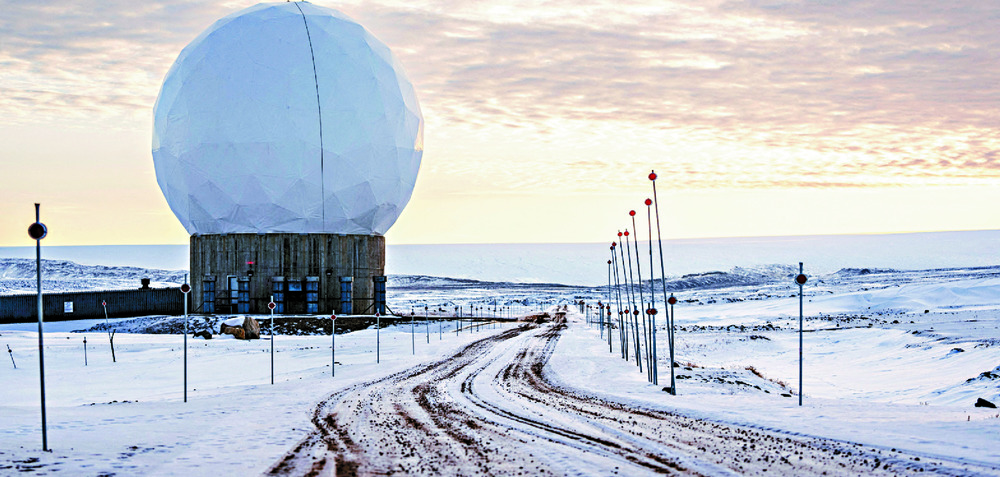
Scott L Montgomery President Donald Trump has sparked controversy by suggesting the United States needs to acquire Greenland for "national security" and refusing to definitively rule out using military force to do so. Trump's interest is not new. He first expressed interest in it in 2019. Given his repeated statements and invocation of national security, it's worth considering what strategic value Greenland might actually have from a US perspective. Its value can be viewed in terms of four fundamental areas. A matter of minerals Its most valuable natural resources lie in its mineral wealth: gold, platinum, zinc, iron, copper, nickel, cobalt, uranium - and rare earth elements such as neodymium, dysprosium and praseodymium. A 2023 geologic survey suggests new deposits will be found as the Greenland Ice Sheet retreats. If fully developed, the Kvanefjeld - or Kuannersuit in Greenlandic - uranium and rare earth deposits would place Greenland among the top producers worldwide. During the 2010s, its leaders encouraged interest from outside mining firms, including leading Chinese companies, before finally granting a lease to the Australia's Energy Transition Minerals (formerly Greenland Minerals). When China's Shenghe Resources took a major share in Energy Transition Minerals, it raised red flags for Denmark, the European Union and the United States, which felt China was seeking to expand its global dominance of the rare earth market while reducing Europe's potential supply. The issue was put to rest in 2021 when Greenland banned all uranium mining, killing further development of Kvanefjeld. That same year saw it also prohibit any further oil and gas activity. Fears of China abroad China's interest in Greenland stretches back at least a decade. In 2015, Greenland finance and interior chief Vittus Qujaukitsoq visited China to discuss possible investment. One firm, China Communications Construction, bid to build two airports, one in the capital, Nuuk, the other in Ilulissat. Another, General Nice Group, wanted an abandoned Danish naval base, while the Chinese Academy of Sciences asked to build a permanent research center and a satellite ground station near Nuuk. None of this sat well with the first Trump administration, which put pressure on Denmark. The Danes and Greenlanders complied, rebuffing Chinese attempts to invest in Greenland-based projects. Long-standing US interest The United States has had a long-standing security interest in Greenland dating from 1946, when it offered US$100 million in gold bullion. The Danes firmly declined. In the early 1950s, the United States built Thule Air Force Base 1,200 kilometers north of the Arctic Circle. Originally a missile early warning and radio communications site, it was transferred to the newly formed US Space Force in 2020 and renamed Pituffik Space Base in 2023. It has updated radar and tracking capabilities to provide missile warning, defense and space surveillance, and satellite command missions. While it also supports scientific research focused on the Arctic, it is intended to increase military capabilities for the United States and its allies. Geopolitics of the Arctic Greenland is situated between the Northern Sea Route and the Northwest Passage, whose importance grows as sea ice shrinks. By 2050, a Transpolar Sea Route is likely to open through the Arctic Ocean, passing Greenland's shores. The island is also the basis of Denmark's claim to the North Pole - rivaled by claims by Russia and Canada. Sovereignty would give access to potentially significant oil, gas and rare earth resources, as well as superior scientific and military access to the Transpolar Sea Route. This dispute is only part of the geopolitical struggle for offshore territory. Russia's growing militarization of its huge coastal area has been countered by NATO, while China's own moves into the Arctic, aided by Moscow, has seen the launch of research stations supported by icebreakers and deals for research and co
Pittuffik Space Base in Greenland. AFP